Tennessee Water Bills: Leaks, Late Payments and Shutoffs
A water bill that suddenly jumps, a leak you cannot locate, or a shutoff warning can be stressful—especially when it is unclear who is responsible or what happens next. Tennessee utilities have different billing rules and assistance options, so the best response starts with the bill itself, a timely call to the provider, and a clear record of what you find.
Start by understanding the bill
Before treating a high bill as a leak—or assuming a late notice is an error—check what the utility actually billed. A statement may cover a period longer than usual, include a prior balance, or combine water with sewer, stormwater, or other services. The total due is not always the amount for water used during that billing cycle.
Look for the service address, billing dates, meter readings, usage units, current charges, previous balance, payment credits, and due date. Compare the current usage with earlier bills for the same address. If the utility estimates readings when a meter cannot be accessed, the next bill may include a catch-up adjustment after an actual reading. Ask the utility to identify whether the readings are actual or estimated and how it calculated the amount.
Water use may be shown in gallons, cubic feet, or another unit. Do not compare figures from bills with different units until you confirm what each number means. If the utility provides a usage history or a way to view daily or hourly use, check it for a sudden change. That pattern can help distinguish a steady leak from a one-time event such as filling a pool or watering a newly seeded lawn.
Also check whether the bill includes a sewer charge based on water consumption. In many places, a leak can raise both water and sewer charges, but a utility’s rules for adjusting either charge may differ. A water credit does not necessarily mean the sewer portion will be adjusted too. Ask the provider which charges are eligible and what documentation it requires.
If you recently moved, confirm that the account’s opening date and meter reading match the move-in record. In a rental, the account may be in the tenant’s name, the landlord’s name, or a property manager’s name. The person responsible for the account depends on the utility’s account arrangement and the lease; do not assume that paying rent automatically settles a water bill in your name.
For context on common causes, see Water Bill Suddenly Higher This Month? Common Reasons to Check. A running toilet or a dripping fixture can use more water than it seems, as explained in A Dripping Faucet and Your Tennessee Water Bill: The Gallons Add Up.
| What you notice | What to check first | Useful next step |
|---|---|---|
| Usage rose sharply | Billing dates, meter readings, toilets, irrigation, and recent unusual use | Ask the utility to confirm the reading and check for continuous use |
| Bill is higher but usage is similar | Rate or service-charge changes, sewer charges, prior balance, and fees | Ask for a line-by-line explanation |
| Bill says estimated | Reading history and access to the meter | Ask when an actual reading will be taken |
| A past payment is missing | Payment date, confirmation, account number, and bank record | Send proof through the utility’s official billing channel |
| A shutoff warning arrived | Deadline, amount claimed, and account holder | Contact the provider promptly and ask what options remain |
The table is a starting point, not a substitute for the utility’s billing policy. A provider can explain how it reads the meter, applies payments, and calculates the charges on a particular account.
Investigate a sudden increase before paying for repairs
A high bill is a signal to check both the property and the account. Start with the simplest explanations, then work toward harder-to-find problems. If the increase is large or the meter suggests water is running continuously, contact the utility and a qualified plumber as appropriate. A utility may be able to verify a meter reading or account detail, but it generally cannot inspect private plumbing inside a home.
First, compare the bill’s usage with the same season in prior years, if those records are available. Outdoor watering, guests, a new household member, a filled pool, or a change in how often laundry is done can explain higher use. Do not assume seasonal use is the cause, though, if the meter continues to register when all intended water use has stopped.
Next, look at fixtures that can leak without leaving a puddle. Toilets are a common place to start. A faulty flapper or fill valve may let water pass from the tank to the bowl, causing the toilet to refill intermittently. Listen for refilling when nobody has used it, check whether the water level keeps moving, or use a simple dye check if the manufacturer’s instructions allow it. Avoid putting coloring agents in a toilet tank if they could damage parts or stain surfaces.
Inspect faucets, showerheads, water-heater connections, exposed pipes, appliance hoses, and outdoor taps. Look for dampness, water stains, mold-like growth, or soft flooring. Check irrigation controls and hose connections, too. An underground irrigation leak can run for a long time without being obvious at the house.
A meter check can help show whether water is moving through the service. Find the meter using the location or instructions provided by the utility, and follow the utility’s safety guidance. Make sure water-using appliances, faucets, toilets, and irrigation are off. If the meter indicator continues to move, water may still be flowing. That does not by itself locate the leak or prove who is responsible; an appliance, a hidden pipe, or a plumbing connection may still be using water.
Some meters are in boxes or vaults that should not be opened or entered by a customer. Do not reach into a meter pit, disturb utility equipment, or attempt repairs on the meter. Ask the provider how it recommends checking usage and whether it can verify the meter or arrange a review. If the meter is not accessible or the results are unclear, a plumber can help trace the problem.
If you suspect the meter reading is wrong, write down the reading and date, take a photograph if the meter is safely visible, and compare it with the bill. Ask the utility to explain its reading method and whether it can recheck the meter. Meter accuracy testing, inspection charges, and the process for requesting a test vary, so ask about the terms before requesting one.
For more possibilities and a practical check order, use Water Bill Suddenly Higher This Month? Common Reasons to Check. If the suspected leak may be between the meter and the home, Leak on Your Side of the Meter in Tennessee: Who Pays? explains why it matters to establish which side of the meter is involved.
Find out who is responsible for the leak
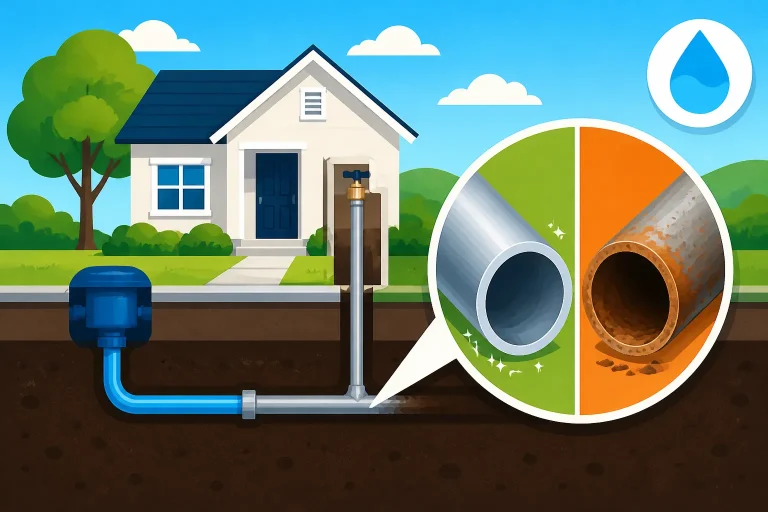
A leak’s location can affect who arranges a repair and who pays for it. In broad terms, water systems maintain their own distribution equipment, while property owners are often responsible for plumbing serving the property. The exact boundary is not identical everywhere. Service-line ownership, meter placement, easements, utility rules, and the property’s layout can affect the answer.
Do not treat the meter as a universal legal dividing line. In some arrangements, part of the service line may be the property owner’s responsibility; in others, the utility may own or maintain some portion. The account holder may also have to report a leak even if the utility is responsible for repairs to the affected equipment. Ask the provider to identify the relevant boundary for the address and point to its current written policy.
If water is visible near a street, sidewalk, meter box, or utility equipment, contact the water provider using contact details on its official website. The provider can tell you whether the issue appears to involve its system or whether you need a plumber. Do not open a meter box, operate valves you do not recognize, or dig near underground utilities. Even when you suspect a leak is on private property, the utility may be able to offer guidance about safe next steps.
For a leak inside the home, a plumber can inspect fixtures, appliances, and pipes. For a leak underground, the plumber may need to trace the line before excavation. Confirm that the contractor has identified the suspected location and documented the repair. Keep the repair invoice and any notes, photographs, or test results; the utility may ask for them if you request a bill review or leak adjustment.
Renters should notify the landlord or property manager in writing as soon as a leak is suspected. Include the date, location, and any evidence, and keep a copy of the message. Do not make a costly repair or authorize excavation without checking the lease and obtaining the required approval, unless there is an immediate safety issue and the lease or local rules provide another process. If the water account is in the tenant’s name, the tenant should still contact the utility about the bill and account options. If it is in the landlord’s name, the landlord may need to handle account-specific requests.
Apartment buildings add another layer: a leak may serve one unit, a shared space, or the building as a whole. A tenant with an unusually high individual bill can ask the landlord whether plumbing or shared-use equipment has been checked. For billing responsibility and next steps, see High Water Bill in a Tennessee Apartment: Who Checks for a Leak?.
Ask about a leak adjustment, but do not assume one is automatic
Some Tennessee utilities have a process for reviewing unusually high bills after a qualifying leak. Others may limit adjustments to certain charges or conditions. The policy can specify which leaks qualify, how soon a customer must report them, what proof is needed, and how often an adjustment can be granted. A repaired leak does not guarantee that a bill will be reduced.
Call or write the utility as soon as you identify a possible leak. Ask these questions:
- Does the provider offer a leak adjustment or billing review?
- Which types of leaks qualify, and which do not?
- Is there a deadline to report the leak or submit a request?
- What proof is required, such as an itemized repair bill, photographs, or a plumber’s statement?
- Can the water charge, sewer charge, or both be reviewed?
- Does the account need to be paid while the request is being considered?
- Will the utility pause collection activity or a scheduled shutoff during the review?
- How will the provider communicate its decision, and how can it be appealed?
Ask for the current written policy rather than relying on a general description. Terms can vary even between nearby communities, and the process for a city utility may differ from that of a utility district or private provider. If the provider says an adjustment is unavailable, ask whether it can review a reading error, estimate, billing period, or payment posting separately.
Prepare the request with a clear timeline. Note when the bill arrived, when the leak was discovered, when the repair occurred, and when the utility was contacted. Include the account number only through the provider’s official channels. Keep copies of correspondence and receipts, and write down the name or department of the person who handled the inquiry, the date, and any next step or deadline.
If the leak is ongoing, ask the provider whether a temporary payment arrangement or other account option is available while the plumbing is repaired. Do not wait for an adjustment decision before contacting the utility about a payment deadline. A review request and a payment obligation may be treated separately under the provider’s policy.
If the account holder disputes the bill, describe the specific issue: an unexpected meter reading, an estimated bill, a leak, a payment that is not credited, or a charge that does not match the account. Asking the utility to “check the bill” may not provide enough detail for staff to determine what to investigate. A concise written request, with dates and supporting documents, creates a useful record.
For a step-by-step look at the review process, see Getting a Water-Bill Adjustment After a Hidden Leak in Tennessee. If the amount is correct but difficult to pay, ask about payment options separately; a pending leak request should not be treated as an automatic extension.
If you cannot pay on time, contact the utility early
A missed water-bill due date can lead to additional charges, collection steps, or interruption of service, depending on the provider’s policy and applicable rules. The timing and sequence are not the same across Tennessee. A notice may explain a deadline, a balance, and ways to contact the provider, but do not assume that every notice gives the same amount of time or offers the same options.
If you know you will be late, contact the utility before the due date when possible. Ask whether the account qualifies for a payment arrangement, extension, deferred payment, or other assistance. These options are provider-specific, and approval may depend on the account’s circumstances or payment history. Get any arrangement in writing or confirm the terms in a message from the utility.
Be ready to explain what you can pay and when. Ask whether a partial payment prevents further action, whether the remaining balance can be divided over future bills, and whether the arrangement covers current charges as well as overdue amounts. Do not assume that a partial payment stops a shutoff process unless the provider confirms that it does.
If the utility offers a payment plan, confirm the required payment dates, amounts, how future bills are handled, and what happens if a payment is missed. Make sure the plan is affordable before agreeing. If the arrangement is not workable, explain that promptly and ask whether another option exists. A promise you cannot keep may make the account harder to resolve.
Payment assistance may be available through community programs, but eligibility, funding, and application procedures vary. Help Paying a Tennessee Water Bill: Where LIHEAP Fits In describes one potential route to investigate. Assistance for household energy costs does not necessarily pay a water bill directly, so check the program’s current rules and ask local community agencies about water-specific help. The utility’s website or billing staff can also identify any programs it recognizes, but do not assume a program is currently accepting applications.
For a broader account-specific checklist, see Need More Time to Pay a Tennessee Water Bill? Who to Ask. When contacting the provider, use its official website to find current billing contact details and accepted payment methods. Be cautious about unsolicited messages or callers demanding immediate payment through unusual methods. If uncertain, end the conversation and call the number listed on the official utility website.
Respond quickly to a shutoff notice
A notice of possible service interruption is time-sensitive. Read it carefully and identify the service address, account holder, balance, deadline, and action the provider says is needed. Check whether the amount includes current charges, an old balance, or a fee. If anything is unclear, contact the utility promptly using contact details from its official website.
Ask the provider to explain what stage the account is in. A reminder, a final notice, and a notice stating that service may be interrupted are not necessarily the same. Ask whether a payment arrangement, assistance application, billing dispute, or payment made after the notice changes the scheduled action. Get a clear answer about what must happen and by when. Do not rely on assumptions about a grace period.
If you already paid, gather the payment confirmation, date, amount, account number, and transaction details. Ask the utility to check whether it was credited to the correct account. If you sent payment through a third-party service, ask the provider how long it takes to appear and what proof it accepts. Keep making contact until the account status is clear, especially if the notice gives a near-term deadline.
If you dispute the balance, explain the reason and ask how to submit documents. Disputing a charge does not necessarily stop collection activity or shutoff. Ask directly whether the utility will pause action while it reviews the issue and request written confirmation. Continue to address any amount the provider identifies as undisputed, if possible, but first confirm how a partial payment will be applied.
If water service has already been interrupted, ask what is needed to restore it, whether an account review is available, and whether any balance or other requirement must be addressed first. Restoration procedures and charges differ by utility, so get the current requirements from the provider. Do not try to reconnect service or tamper with a meter or valve. That can create safety risks, damage equipment, and complicate the account.
If a household member has a medical or accessibility-related need for water, tell the utility and ask whether it has a process for documenting special circumstances. Do not assume that a medical need automatically prevents interruption; requirements and protections can vary. For questions about health effects or what water use is appropriate during an interruption, ask a medical professional or local health department.
The provider’s current policy is the most reliable place to confirm notice stages, payment options, and restoration steps. Water Shutoff for Nonpayment in Tennessee: Notices and Options covers the issue in more detail. If you believe a utility has not followed its own policy or you cannot resolve an account dispute, keep a dated record and ask the provider how to request a formal review. For regulatory or legal questions specific to a dispute, consult a qualified professional.
Prevent repeat surprises and keep useful records
A few small habits can make a high bill easier to catch and a billing dispute easier to resolve. Save each bill or download it from the provider’s account portal. Track usage over time, not just the amount due. A household’s baseline can change with the season, household size, appliances, and outdoor use, but a sudden unexplained jump deserves a closer look.
Check toilets and visible plumbing periodically. Watch for a toilet that refills without being used, a faucet that drips, damp spots under sinks, or water collecting near an outdoor tap. Check irrigation systems after seasonal start-up and after repairs. If the property will be vacant, arrange for someone to check it and know how to contact the utility if a leak appears. Ask a plumber about shutting off water safely if that is appropriate for the property and circumstances.
Know where the property’s main shutoff is, but do not operate utility-owned equipment. If a pipe bursts, shutting off the home’s plumbing may limit damage, but a meter or street-side valve may belong to the utility. If you are unsure which valve is safe to use, ask the utility or a plumber before an emergency.
Set reminders for due dates, and check whether the provider offers notifications for unusually high use, due dates, or payment status. Availability varies. Keep account contact information up to date, particularly after a move or a change in the person responsible for the account. If the account is shared or managed by a landlord, agree on who will receive notices and who will contact the utility.
Keep a simple file for unusual events: the bill, meter reading, leak photos, repair invoice, messages with the utility, payment proof, and any adjustment decision. A short timeline can prevent confusion later. For example, record the date the leak was found, when the repair was completed, and when the utility was notified.
If you move, confirm how the account is closed or transferred and ask for a final reading. Keep proof of the request and final payment. A former account holder should not assume the service automatically moved to the new resident, and a new resident should not assume that the prior account’s balance is theirs. Ask the utility how it handles account changes at the service address.
Finally, separate three questions that often get tangled together: Is the usage accurate? Who is responsible for fixing the leak? Can the bill be paid by the deadline? The utility can explain readings, billing rules, and account options; a plumber can locate and repair private plumbing; a landlord or property manager may need to handle building repairs; and assistance agencies can explain whether a household qualifies for help. Addressing each question with the right party is usually more effective than waiting for one answer to solve all three.
Frequently Asked Questions
Can a Tennessee utility shut off water for a late bill?
A provider may have a process that can lead to interruption for nonpayment, but notices, timelines, and options vary. Read the notice and ask the utility what action is required and by when. Confirm current rules with the provider or an appropriate professional.
Will a utility reduce my bill after a leak?
Possibly, but an adjustment is not automatic. Eligibility, deadlines, documentation, and which charges can be reviewed depend on the utility’s written policy. Contact the provider as soon as the leak is identified and keep repair records.
Who pays for a leak between the meter and the house?
Responsibility depends on the provider’s service-line rules, the property arrangement, and where the leak is located. Ask the utility to identify the ownership and maintenance boundary for the address before arranging work.
What if my bill is based on an estimated reading?
Ask the provider to explain why the reading was estimated and when an actual reading will be taken. Compare the bill with the meter only if it is safely accessible, and ask how the provider handles a correction if the estimate is inaccurate.
Can I get help with a Tennessee water bill?
Some households may find assistance through local or community programs, but availability and eligibility vary. Contact the utility and potential assistance providers directly to confirm current options, deadlines, and documentation requirements.
Disclaimer
This article is for general informational purposes only and does not constitute professional advice. Laws, prices and regulations vary by location and change over time. Consult a qualified professional for guidance on your specific situation. Tennessee Water Guide is not a government agency or water utility and is not affiliated with any public water system.